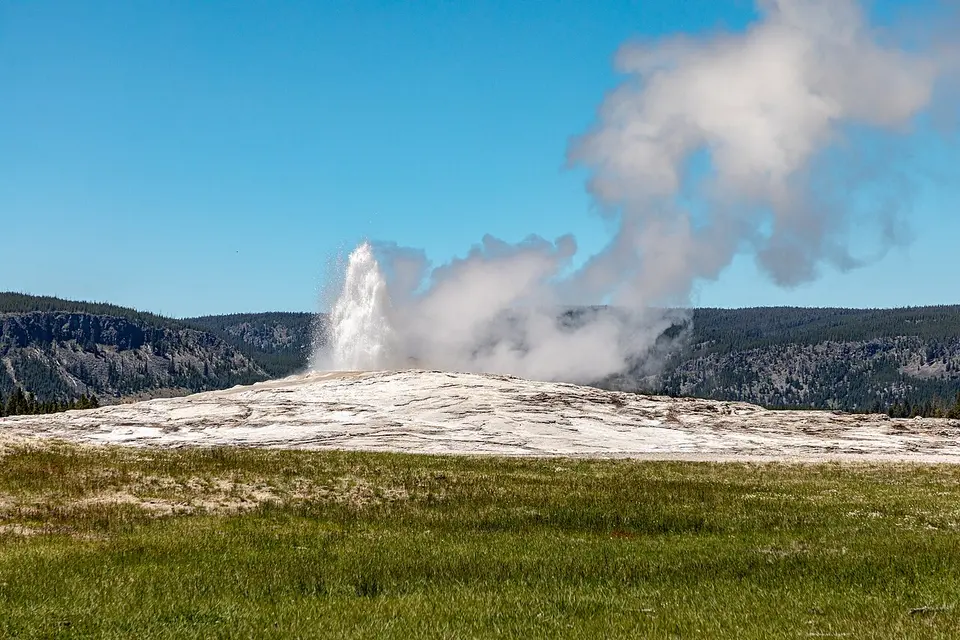
The planning decision. Yellowstone covers nearly 900,000 hectares and the National Park Service (NPS) identifies five entrances, ten visitor centres and eight developed service areas. It is not a single geyser stop. A useful visit begins by choosing what matters most — hydrothermal landscapes, the canyon and waterfalls, lake country or wildlife habitat — and only then checking which roads and services are open on the chosen dates.
Different regions answer different interests
The Old Faithful area groups geysers and a visitor education centre. Madison and the west connect visitors with other hydrothermal landmarks, including Grand Prismatic Spring. Canyon has waterfall and canyon viewpoints, including Upper and Lower Falls. Lamar Valley and the northeast are known for landscape and wildlife viewing. These are planning categories, not a claim that they fit comfortably into one day or that wildlife will appear on demand.
The NPS warns that Yellowstone is strongly seasonal. Few facilities operate year-round, and services become limited from early November to late April. A summer map is not an access guarantee for an autumn or winter trip. Check current conditions and facility operating dates before settling on lodging, entry side or a driving loop. Exact drive times would be misleading without a date and road status.
Use the official NPS park map rather than a generic GPS address. NPS warns that navigation apps can send drivers onto one-way roads, remote dead ends or seasonally closed routes. Choose an entrance and region before setting off.
Hot springs are for viewing, not a bathing plan
The hydrothermal areas are a defining feature, but they are not a substitute for a managed hot-springs pool. NPS describes a severe burn hazard: apparently solid ground around thermal features may be a thin crust over superheated water. Follow designated paths and boardwalks and check the current safety rules. A visitor hoping to soak should not improvise a bath at Old Faithful or Grand Prismatic. The difference between seeing geothermal features and swimming in a supervised facility is central to choosing the right destination.
Wildlife and driving need separate care. NPS notes that animals are wild and can be dangerous; it also identifies traffic-related incidents as a major injury risk. View animals from appropriate distances and do not let a sighting turn a narrow road into an unsafe stopping point. The exact guidance for bison, bears and specific activities should be read on the NPS safety pages before travel.
Questions worth settling
Can I cover the whole park in a day? NPS’s five entrances and dispersed regions make that a poor default assumption. Prioritise a region and test the route against current access.
Can I bathe in the hot springs I see in photos? Do not treat hydrothermal features as swimming pools. NPS warns about serious burns and unsafe ground.
Are the roads and visitor centres open year-round? No general promise is possible. NPS publishes changing conditions and operating dates by facility.